
World of AI – Mastering Change with Poise
I like how teachers in China are using AI in a positive manner to show students in their dream jobs. Watching the squeals of happiness of the students made me smile big time.
AI covers a whole range of tech, from machine learning to robotics and even how we process and understand language. Generative AI, though, is more like the creative branch of AI, it’s all about making new stuff. Think text, images, music, code, or video. It works by using models trained on heaps of data to whip up original content based on what you ask it for.
AI is a change that is happening and seeping into our lives regardless of our feelings about it. I’ve included it in this month’s theme of Grace because like all the other changes in history, our ability to adapt with the greatest ease of flow will allow us to continue to flourish.
I know there are many concerns expressed about it. I had mine too and hence, adopted it rather late compared to my peers. 😊
Embracing change is always tad challenging be it new technology, a shift of lifestyle or new portfolios.
Did you know that when the telephone was first introduced, not everyone was shouting, “Hello!” with excitement? Alexander Graham Bell had this vision of connecting homes with wires so people could chat without braving the great outdoors. Groundbreaking, right? But some people weren’t sold. They basically said, “Why bother? We’ve got messengers and errand boys for that!” Imagine if he had listened to the naysayers.
While I no longer have a house phone, I cannot imagine not having my mobile phone to communicate and work with.
Cars had their own drama in the early days, much like the telephone. For example, Alexander Winton, an early car manufacturer, faced ridicule for his invention. He recalled being called “the fool who is fiddling with a buggy that will run without being hitched to a horse”.
During the pandemic, when companies had to switch to working from home and zoom boomed, it meant embracing this change so we can pivot and survive. As someone used to in person sessions, I had to quickly adjust to the new way of doing business. Initially, clients were apprehensive about the efficacy of online but they soon grew to love it.
Embracing the online tools soon opened new pathways for me. While my team at Positive Performance Consulting is still based in Singapore, I work remotely majority of the time.
Likewise, I view AI as yet another tool that we can leverage on. The ability to use it as a catalyst for positive or damaging change always lies within our locus of control. Take cars, they provide convenience yet if we just choose to drive everywhere then it affects our well-being for lack of exercise.
I like to share three stories of embracing change related to technology.
Story 1: Staying Connected
During the pandemic, I taught my parents how to use the WhatsApp Video call so that we could stay in touch regardless of our locations. What I learnt from this experience is that how we teach others to embrace technology is critical. While using Whatapp video is the norm for many, it wasn’t to my parents. I spent time demonstrating how to use it till they are comfortable with it. It highlights the importance of not assuming that learning and usage is easy for everyone. Also to be patient when teaching others. I am grateful for teaching them because I can now video call my parents regularly.
Story 2: Pivoting to Online Sessions
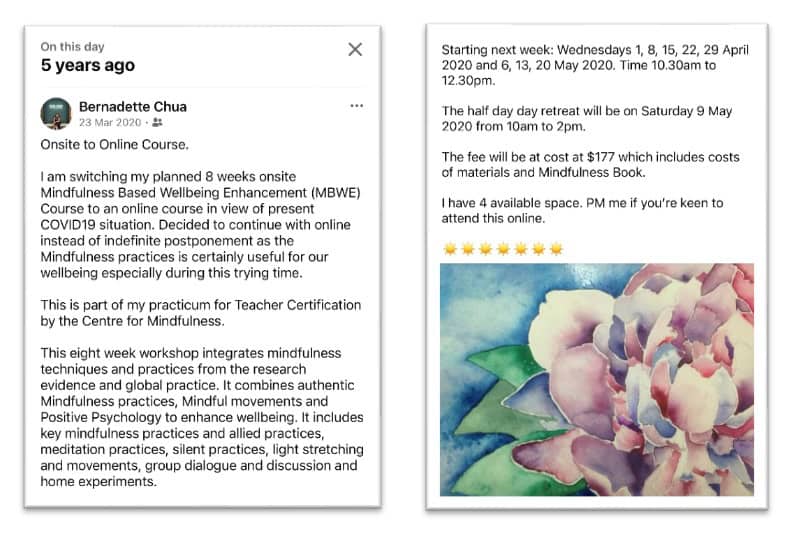
I mentioned earlier that we, like many, had to pivot to online during the pandemic. My first foray into online was a huge learning curve because I had to do it for a mindfulness course as part of my practicum to be a Mindfulness Teacher. Grateful to participants who were gung-ho enough to try. What I learnt from this is that it is perfectly okay to admit that I am learning to master the tool and open to suggestions. The curve balls we are thrown can be an opportunity for learning and growth.
Story 3: Traditional and AI
Recently, I was invited to attend an online course by a Traditional Chinese Medicine & Taoist Medicine Physician based in China. Those who know me personally know I am not fluent in Mandarin so saying yes was a step forward. 😊 In the last few sessions, he demonstrated using an AI programme to do health checks. Those who volunteered as test subjects all had health checks reports by hospitals. He then uses the AI programme to do the tests and compared both reports. The results were amazingly similar. What I admired even more was this physician’s willingness to adapt and utilises the AI to augment his capabilities. He shared that with this AI tool, his group of fellow physicians can help their clients more easily.
My parents, the physician and I are putting into practice the quote by Charles Darwin:
“It is not the strongest of the species that survives, nor the most intelligent that survives. It is the one that is the most adaptable to change.”
It is a quote that I often use to encourage leaders and their team members to embrace change so that they continue to flourish.
Reality is that AI is a change that is happening. While it brings uncertainty, they also open doors for innovation, growth, and deeper personal reflection.
Instead of shunning it, how can we embrace this change gracefully so we can continue to flourish?
When change seeps in, is it possible for us to pivot and discover new rhythms like a graceful dancer even when the tempo changes?
Here are some insights and suggestions on how we can embrace change more gracefully:
1. Understand Your Resistance
Everyone’s resistance to change or adopting a new tool/ strategy is different. In companies, when they simply roll out a new initiative without addressing possible resistance, adoption rate tends to be slower or low. In the same way, greater self-awareness about your resistance or fears allows you to address and release them.
For example, my initial resistance to Generative AI probably stemmed from my need to preserve my creativity as a writer and author. Also concerns about integrity and intellectual rights for example, there was a stir recently with the trend of turning photos into Studio Ghibli-style masterpieces. It’s hugely popular, but not everyone’s thrilled. There has been a fair bit of controversy around ethics, copyright, and whether it’s stepping on the toes of artists who rely on their craft for a living. Hayao Miyazaki, the founder of Studio Ghibli, called AI-generated art “an insult to life itself.”
After chats with others who have been leveraging the use of Generative AI, I found a happy medium for me. As the process of thinking and crafting my thoughts creates immense joy for me, I intentionally ensure that the content I write for these Sunshine Inbox is mine. I use it for my research to enrich my writing.
Another friend’s resistance to AI is her fear of security. She had to find a way around that fear before she can embrace it.
If you are working with a team, you may like to read this post I did on Managing Your Team’s Resistance to embracing change.
2. Get Help or Support to Embrace the Change
One of the biggest stumbling blocks to embracing change or new technology is our discomfort in admitting that we do not know how to do it. Most of us have an innate dislike of asking for assistance or help; perhaps a fear of a loss of face or we feel bad imposing on others.
Reality is there will be others who may be more adaptable or quicker to learn than us. That is great because they can teach us!
I remember attending a course in 2016 where one of the modules was on digitalisation and technology. I dreaded that module, the terminology of blockchain, digital forums, tech stuff terrified me. So I decided to confess to my lecturer and fellow course mates that “I am a digital dinosaur but I am open to learning as much as I can.”
When I opened up, another classmate also shared about his discomfort. We were the two digital dinosaurs compared to our tech savvy peers. By being open and vulnerable, we received a lot of support from our lecturer and our course mates.
Later on, I was able to use this experience to share with companies and business leaders in my consulting work on supporting their teams to embrace change. I was even invited to be a closing speaker for a Digitalisation Forum a few years later. Certainly a change from feeling like a digital dinosaur! 😊
3. Be Growth Minded in Embracing Change
In Mindset: The New Psychology of Success, psychologist Carol Dweck shares how having a growth mindset can motivate people to reach their goals and success. This applies to any skillsets that we want to learn and when we are in a new situation.
When we are growth minded, we believe that intelligence can be developed, which leads to a desire to learn and therefore a tendency to:
As a result, people with a growth mindset reach ever-higher levels of achievements. We are also able to embrace change a lot more gracefully.
Discover New Rhythms
Reflection
Action
Whenever we learn something new or step into a new role, we will go through the four stages of learning or the stages of competence created by Noel Burch in the 1970s as a model for learning. Knowing where you are at in terms of the learning stages gives you greater awareness and allows you to excel in mastering new skills.
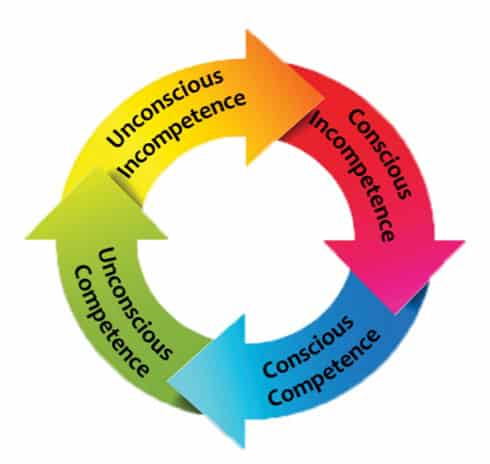
Unconscious Incompetence: At the Unconscious Incompetence stage, we do not understand or know how to do something and possibly do not recognise this deficit.
Conscious Incompetence: This is the ‘Aha!’ stage, where we recognise both the deficit as well as the value of the new skill(s). You may not understand or know how to do it yet. The making of mistakes may have sparked off this stage. This is where having a growth mindset is valuable for you and those around you. When others are at this stage, your response to them is critical. Be supportive and encouraging instead of saying: “it’s so easy, you don’t know how to do it?” or “Huh? Everyone knows how to do this!”
Conscious Competence: At this stage, you understand or know how to do something. However, demonstrating the skill or knowledge requires focus. It may be broken down into steps, and there is heavy conscious involvement in executing the new skill. Patience is a virtue especially at this stage. Setting incremental goals could be a great strategy as you seek to master this new skill.
Unconscious Competence: You now have had so much practice with the skill that it has become ‘second nature’. You can do it effortlessly without thinking about it. As a result, the skill can be performed even while executing another task. You may be able to teach it to others, depending on how and when it was learned. I encourage my clients to continue to remain curious when they reach this stage in their learning journey. This allows them to remain attuned to changes or updates required.
Practice for the Week
I received the following video in 2016, it encourages me that we can continue to value create. After watching the video, have a think about your response and how will you discover new opportunities? Love to hear your thoughts on our FB Closed Group!