
Growth Mindset. Undeterred by Failure. Continual Motivation.
A big thank you to those who responded to my invitation to shape this month’s Sunshine Inboxes. Centred around the theme of BREAKTHROUGH, you shared your thoughts and reflections on:
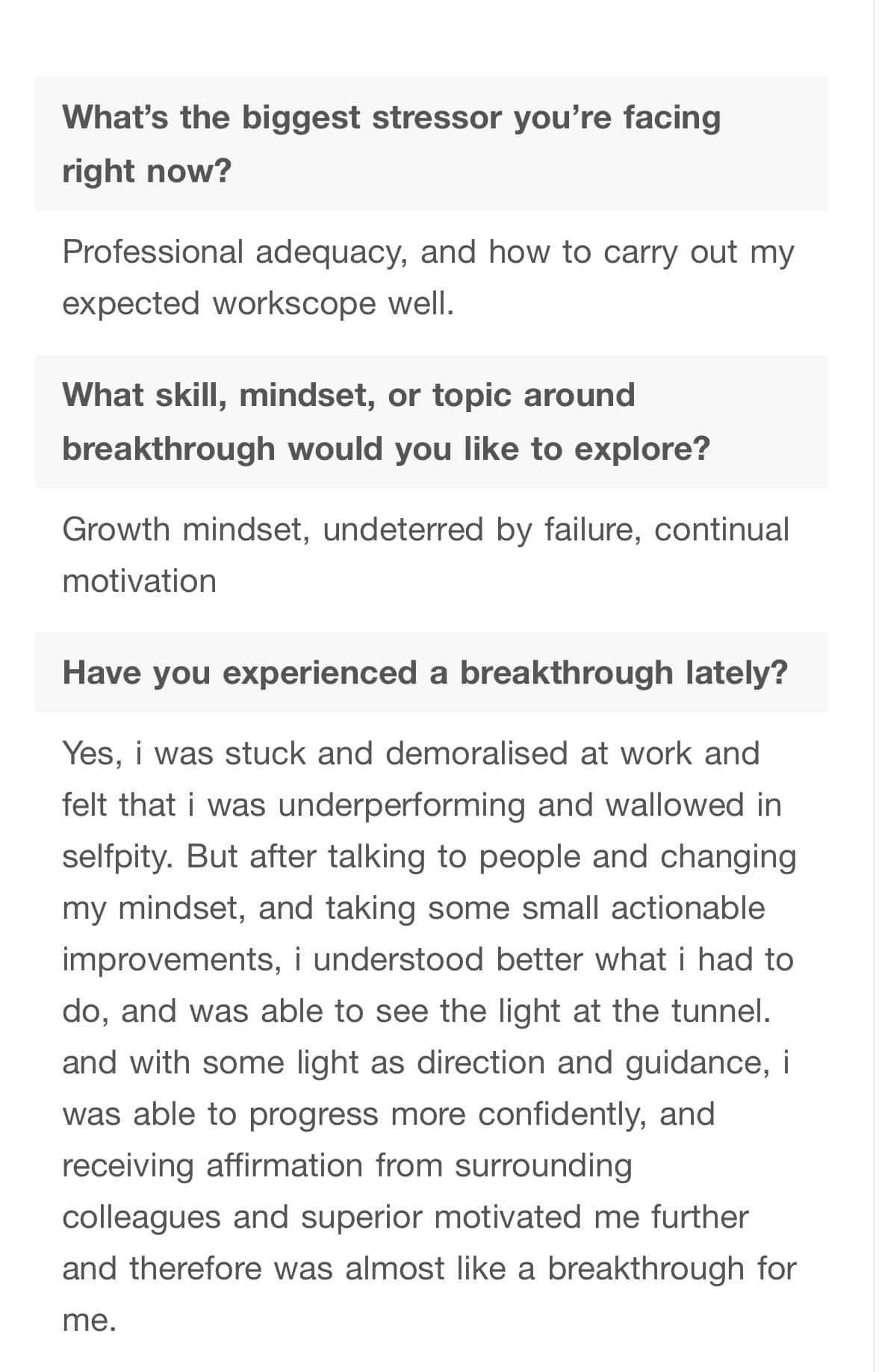
In the weeks ahead, I will share my thoughts and insights based on a first-received-first-shared basis. In the first survey response received, the member shared that the biggest stressor faced is professional adequacy and how to carry out the expected work scope well.
Based on my 1-to-1 sessions with clients and corporate consulting, this sense of professional inadequacy surfaced frequently. Particularly from those who are highly competent in their role and highly responsible professionals. Which leads me to a thought: perhaps it is useful when we occasionally feel this sense of professional inadequacy. As it means we are self-aware and continuously do self-check to ensure growth. Another common factor that surfaced is feeling the imposter syndrome.
Happy to read the breakthrough that the member experienced, congrats on that! It takes great awareness and courage to recognise that we may be on a self-pity mode, not many are willing to do that. With that awareness, breakthrough happens.
For those experiencing professional inadequacy, you may like to read Sunshine Inbox Week 11 (12 March 2025) where we covered on Are You Ready to Believe in You including Imposter Syndrome.
Growth mindset is a favourite topic of mine since I first read it in Professor Carol Dweck’s book. It so inspired me that I designed a Learning & Development Workshop centred around Mindsets for Personal, Professional and Team Success. I also persuaded companies that I consulted in to include the Mindsets Workshop as part of their onboarding programme.
For those of you new to Growth Mindset, I highly recommend you read her book Mindset: The New Psychology of Succes and also Psychologist Angela Duckworth’s book Grit: Why Passion and Resilience are the Secrets to Success.
In the meantime, here is an extract from my book Freedom Embraced: How to Flourish and Be Happy at Work in which I suggested adopting a growth mindset as a way for us to continue enjoying our work.
Chapter – Enjoying Work
Strategy #5: No Natural Talent? Grow Your Ability
When the pandemic arrived and employees had to work from home, one of my clients shared that he was glad his colleagues had previously attended our workshop on Mindsets for Personal and Professional success.
By adopting a learning and growth mindset, the team adapted to the significant changes easier than expected. Team members supported each other and were patient with each other’s learning pace. Colleagues were not afraid of asking questions.
In Mindset: The New Psychology of Success, psychologist Carol Dweck shares how having a growth mindset as leaders, teachers, parents, coaches, etc., can motivate people to reach their goals and success. Praising effort rather than talent has long-term positive effects.
I would like to share something about my art teacher Diana, who demonstrates this growth mindset when teaching her students, and the immense impact it has.
I was terrible in art in secondary school and believed that I had no talent. Then in 2012, a friend connected me with Diana as I was interested to learn how to paint.
‘The Heart’ was completed at my first lesson. It was only possible because Diana shared that everyone could learn how to paint.

As such, I focused on picking up the techniques required rather than on my past experiences of scoring low marks in art.
This applies to any skillsets that we want to learn and when we are in a new situation, for example a new job.
‘Overwhelmed with info and trying to reframe my own mindset and take it easy first. One task at a time, one day at a time!’ was the reply that a client gave when I messaged her to check how was her first week at a new job.
My reply to her was: ‘That’s a useful strategy to adopt during the onboarding period when you’re a newbie in many ways and your team is more experienced. This is where the growth and learning mindset comes into play. Treat all experiences from the perspective of learning and growth. That makes it a more enjoyable journey.’
She is a professional with years of leadership experience. But that does not mean an automatic ease of transition to a new job and environment.
If she had a fixed mindset, it would have made the onboarding experience an unpleasant one. A fixed-mindset leader will feel embarrassed to check with their team members on areas where they may be unfamiliar or unsure.
People with a fixed mindset believe that intelligence is static, which leads to a desire to look smart and hence a tendency to:
As a result, they may plateau early and achieve less than their full potential. Examples are leaders or long-time employees who refuse to upgrade their skillsets.
On the other hand, the growth mindset believes that intelligence can be developed, which leads to a desire to learn and therefore a tendency to:
As a result, people with a growth mindset reach ever-higher levels of achievements.
Khairul had attended a public run of the mindset workshop. Sometime later, he messaged me to share that the workshop had inspired him to develop the growth mindset. It also gave him the courage to take a break from work to pursue his Master’s overseas in spite of the many naysayers who tried to dissuade him. Today, he’s completed his studies and has embarked on new path.
To me, the most important information is that we are all born with a growth mindset. Babies do not stop learning to crawl, stand and walk because they decide it is too hard and not worth the effort. They fall, get up, and barge forward.
But as soon as they become able to evaluate themselves, some of them become afraid of challenges. They become afraid of not being smart.
Dweck studied thousands of people and in one study, she and her researchers offered 4-year-olds a choice: they could redo an easy jigsaw puzzle or they could try a harder one. They found that even at this tender age, children with a fixed mindset (the ones who believe in fixed traits) stuck with the safe puzzle. ‘Kids who are born smart don’t do mistakes’ – they want to make sure they succeed. Smart people should always succeed.
On the other hand, children with a growth mindset (the ones who believe you can get smarter) chose one hard puzzle after another. They thought it was strange that anyone would want to keep doing the same puzzle over and over again. Success is about stretching oneself. It’s about becoming smarter.
Understanding the growth mindset has many useful applications, both on a personal and professional level. We may have a growth mindset for one aspect of our lives, and a fixed mindset in another. For example, we may have a growth mindset as a manager but a fixed mindset when it comes to our relationship with our spouse.
The way we self-talk/self-coach, handle situations and relate to people will be totally different depending on the choice of our mindset. The way we motivate ourselves and others will also be entirely different.
In my consulting work with companies, leaders can begin to build a growth minded environment by:
Some building blocks that team members can be equipped with include:
What’s awesome is that with armed with growth mindset and grit, it certainly enables us to pause and embrace our club’s belief: Your past and present does not determine your future. Dream all ages.
“The major factor in whether people achieve expertise is not some fixed prior ability but purposeful engagement.”
– Robert Sternberg
Mindsets for Success
Reflection
Action
Read and reflect on the following:
“A few modern philosophers… assert that an individual’s intelligence is a fixed quantity, a quantity that cannot be increased. We must protest and react against this brutal pessimism… With practice, training, and above all, method, we manage to increase our attention, our memory, our judgement, and literally to become more intelligent than we were before.” Alfred Binet, Inventor of the IQ Test “Modern Ideas About Children”
Binet is a Frenchman working in Paris in the early twentieth century designed this test to identify children who were not profiting from the Paris public schools so that new educational programmes could be designed to put them back on track. Without denying any individual differences in children’s intellects, he believed that education and practice could bring about fundamental changes in intelligence.
9 types of Intelligence
1983 American Developmental Psychologist Howard Gardner described 9 types of Intelligence.
School puts certain types of intelligence on a pedestal and ignoring other types. If you are not good at math or language, you might still be gifted at other things but it was not called intelligence.
Eg being a maths whiz gave you the ability to understand the world, so does being “people smart” give you the same ability, just from a different perspective.
Not knowing maths, you may not calculate the rate at which the universe is expanding but you are likely to have the skills to find the right person who does.
Practice for the Week
Each day this week, take a few minutes to notice a moment when your inner voice whispers doubt, perfectionism, or self-judgment. Instead of silencing it, gently reframe it using the language of growth. For example: