
Follow Your Intuition
I came across a LinkedIn post by one of our club members Annabelle Loke which gave me great joy. Here’s an extract from it:
“I’m starting a newsletter!
Intuition is something I frequently rely on when it comes to people.
When I notice someone who seems a bit low on energy, a little lost, I feel the urge to reach out. Sometimes I share a personal story. Sometimes it’s something I’ve read or heard on a podcast. Sometimes a reminder that they’re not alone. These are the moments that light me up, a chance to uplift someone.
Lately I’ve been thinking, what if I use this platform to extend this with a ripple effect through my writing. Carve out time to bring these stories from thoughts into writing with clarity and purpose.”
Congratulations Annabelle on starting your newsletter and for following your intuition. If you like to read her full post and also to sign up for her newsletter, you can do so here: Lead with Belle.
For the past two decades, I have been inviting and encouraging people to trust their intuition equally as much as their intelligence. That’s why it gave me such immense joy to read Annabelle’s post.
My learnings, experience and observations showed that to fully follow your bliss and passion, often times, you need to trust your intuition on the actions you like to take. These actions may run counter to what others or your environment says.
Your intuition is a precious resource and one that you can strengthen with practice.
Intuition through the lens of diverse wisdom traditions:
Evolutionary Psychology & Indigenous Traditions – Survival Wisdom (Gut Instinct)
This is the primal “yes” or “no” that surfaces before thought. Evolutionary psychology sees it as a survival mechanism, while many Indigenous cultures honour it as ancestral knowing passed through generations and felt in the body.
Sufi Mysticism & Confucian Thought – Heart Wisdom (Emotional Intelligence)
Sufis speak of the heart as the seat of divine perception, while Confucianism values relational harmony and moral intuition. Both traditions suggest that true understanding arises from attunement to others and to one’s own emotional truth.
Jungian Psychology & Ancient Greek Philosophy – Creative Wisdom (Visionary Intuition)
Jung called this the realm of the unconscious and archetypes where symbols and dreams guide us. Plato believed in innate knowledge of eternal forms, accessed through contemplation. This is the spark that sees beyond the obvious.
Vedanta, Taoism & Tibetan Buddhism – Universal Wisdom (Soulful Knowing)
Vedanta describes intuition (sakshatkara) as direct insight into Brahman, the ultimate reality. Taoism invites effortless alignment with the Tao through wu wei. Tibetan Buddhism sees intuition as spontaneous wisdom that transcends time and space. All point to a deeper, interconnected knowing.
Intuition isn’t reserved for mystics or creatives. In fact, successful people often utilise it. Warren Buffet is an example of intuition backed by experience.
Born in 1930, he is the chairman and CEO of Berkshire Hathaway and widely regarded as one of the most successful investors of the 20th and 21st centuries. Known as the Oracle of Omaha, he built his wealth through value investing ie buying strong companies at reasonable prices and holding them long-term.
While Buffett emphasizes rational analysis, many observers note that his decision-making reflects intuitive discernment developed over decades. His ability to recognize patterns in business performance and market sentiment allows him to make confident choices others might overlook.
Notable examples include:
Looking back on my own life, there are many examples of heeding my intuition and following my bliss. Even when it didn’t make sense.
For example, when I said yes to attending my friend’s workshop to support her, I would never have imagined that two years later, I will quit my job to start my own business. There were many naysayers who chimed in when I wanted to start my own business. I listened to my intuition more than my intellect and I am so glad I did that.
Through that path and new network, that’s where I met my most compatible partner. Having a loving relationship has been my heart’s desire for the longest time.
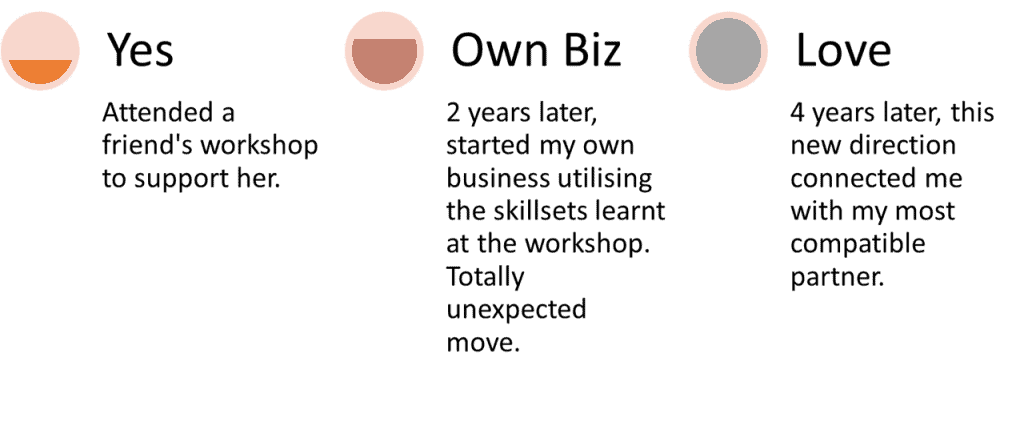
Honouring my intuition to start my business connected me to him. For that, I am so grateful that I learnt about the power of intuition and the happiness it can bring.
Your first yes to your intuition may pave the way for the unfolding of goodness in the future.
Awaken Your Intuition
Reflection
Action
This week, I invite you to test out the following Somatic Exercise ‘Body Compass Check-In’. This practice helps you tune into your body’s intuitive signals before making a decision or reflecting on a situation. It will be more useful to do the practice during daytime.
Somatic trust is the quiet confidence that your body knows before your mind explains. It’s trusting what you feel, not just what you think. When we listen inward and honour the subtle signals without needing to justify them we begin to lead from a place that’s wise, grounded, and alive.
Step 1 – Settle In: Find a quiet space. Sit or stand comfortably. Take three slow breaths and let your attention rest inward.
Step 2 – Bring to Mind a Choice or Question: Keep it simple. Something you’re considering or feeling curious about. Say it internally like, “Should I reach out to ___?” or “Is this direction aligned for me?”
Step 3 – Notice the Felt Response: Say the question out loud or in your mind, then pause. Scan your body slowly, from head to toe. What do you feel? Do you notice warmth, ease or openness? Or tension, tightness or contraction? Don’t force an answer, just observe. Sensation is often your first language of intuition.
Step 4 – Anchor What You Discover: Journal briefly: “When I asked ___, my body felt ___. That tells me…” Even if no clarity comes right away, this builds the muscle of noticing.
Practice for the Week
After meeting someone or entering a space, jot down your first gut response. Revisit it later to see how accurate it was. This builds trust in your initial sensing.