
Are You Lucky?
During my research for this inbox on luck, I saw a recommendation for a book called The Luck Factor by Dr Richard Wiseman.
As I was travelling then, I logged onto the NLB app (created by Singapore’s National Library Board to be a personal library anywhere anytime) to find an e-version of it.
It was not available.
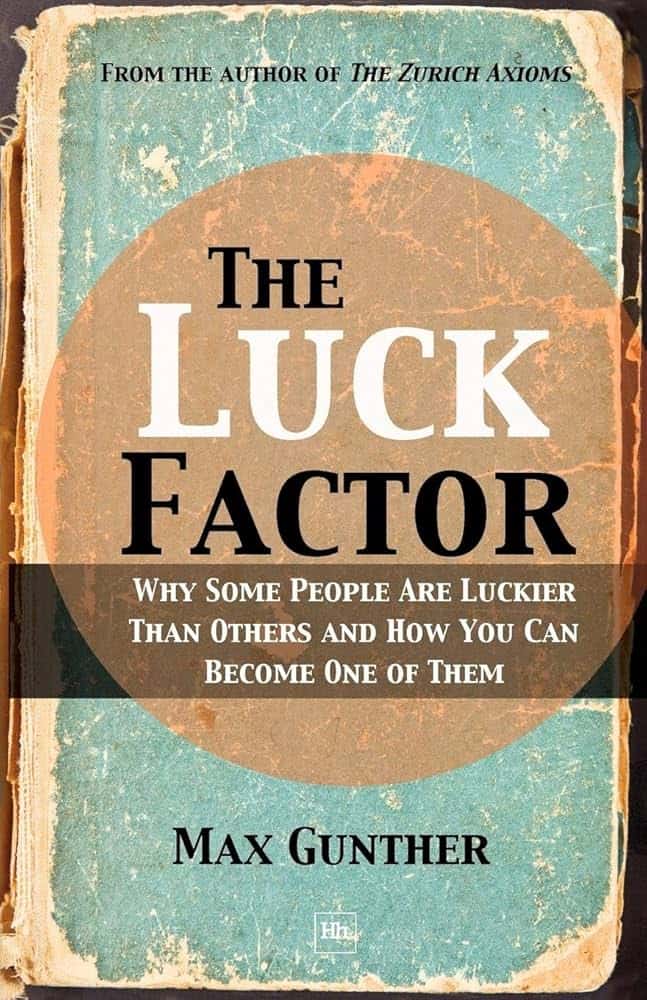
Instead, I saw this book by Max Gunther.
It was first published in 1977 which has my fave number 7. Of course, I got it. 😊
Finished it within a day, fascinating read.
Totally agree with what the editor’s note commented: “You hold in your hands a long lost title restored to life. When Max Gunther’s The Luck Factor went out of print, readers were deprived of one of the more fascinating and readable titles on that great compelling subject: luck.
This journalistic exploration filled with fascinating stories – married to provocative advice and analysis – was lost in the mists of time and secondhand bookshops.”
In today’s Sunshine Inbox, I will briefly share the author’s theory of luck adjustment and the 5 major characteristics that lucky people exhibit. It is definitely worth your time to read this classic.
He opens the book by inviting us to:
“Prepare yourselves for a strange journey. We are about to explore a place that few have ever tried to explore before: the territory of luck. It is unexplored – mainly because many men and women believe it to be unexplorable, not an area you can make sense of. The word luck in this view, is just the name we give to the uncontrolled and uncontrollable events that crash in and out of our lives. It is no more possible to map those events, many would hold, than to map the surf of a wild ocean. To reduce it to order, to measure its fearful geometry: such an undertaking seems bound to fail.
But you will discover, before we reach the end of this quest, that your luck is not as wild a thing as you may hae supposed. Within limits, but in a perfectly real way, it can be influenced.
Sense can be made of it.
It can be handled rationally.”
As someone who refused to believe that I was “fated” to be unhappy, broke, overweight etc, Gunther’s words speak to me loudly.
If I had listened to those who ask me to accept my lot in life or in one ex-friend’s words “so what if your marriage is hell, you just live with it”, I would not be living my dream life and supporting others to do likewise.
Gunther goes on to share “to handle it (luck) – to improve the odds in favour of good luck and diminish the odds of bad luck – you will need to make some changes, perhaps fairly profound ones, in and around yourself. These changes interlock with and complement each other. Together they form what I call the luck adjustment. The theory of luck adjustment is based on observations of consistently lucky as against consistently unlucky people – hundreds of observations, spread over more than two decades. It turns out that the lucky exhibit five major characteristics which, in the unlucky, are either muted to the point of ineffectuality or aren’t there at all.”
The five major characteristics:
1. The Spiderweb Structure
A spider strings many lines to catch passing flies and the bigger her web, the better she eats. In the same way, the luckiest people are those who have taken the trouble to form a great many friendly contacts with other people. He goes on to share examples of people who seemingly are lucky but when you look at their lives, they have consistently supported others and enjoy connecting with others.
While I am not a fan of formal networking per se, I sure enjoy connecting and conversations with others. I am curious about people’s well-being and if I can, to further support them. A lot of my lucky breaks came from the relational networks that I have built through the years. For example, clients and jobs referrals. Likewise for the people I know who are able to manifest new dreams.
For example, one of my clients was able to jump from a sales role to a GM role because she was having coffee with one of her suppliers. He then recommended her to a leader who was in Singapore interviewing candidates. She wasn’t even on the original list of candidates but was chosen. Good fortune indeed thanks to her love for keeping in touch with her network.
2. The Hunching Skill
Lucky people generally have the ability to generate accurate hunches, to trust and act on them. In the book, Gunther shares that “a hunch is a conclusion that is based on perfectly real data – on objective facts that have been accurately observed, efficiently stored, logically processed in your mind. The facts on which the hunch is based, however, are facts you don’t consciously know. They are stored and processed on some level of awareness just below or behind the conscious level. This is why a hunch comes with that perculiar feeling of almost-but-not-quite-knowing. It is something that you think you know, but you don’t know how you know it.”
The challenge is that for most of us, we tend to ignore these hunches thinking “I am being irrational”.
It was the same for me when my then boyfriend kissed me for the first time. Physically I shuddered but I ignored it. My body was already telling me that he is not the right one but my mind with its fears of “being left on the shelf because I was ugly and fat” took over. I was only 18 years old then and looking back, I wished I had honoured that hunch more.
3. The ‘audentes fortuna juvat’ phenomenon
This old Latin aphorism ‘Fortune favours the bold’ is not unequivocally true but it has some very important elements of truth in it. As a group, lucky people tend to be bold people.
One research of Princeton University graduates at their 25th graduation anniversary reveals that the luckier group of graduates were lucky at least partly because they had not been afraid to take risks in their lives – in some cases to take risks very frequently.
There is both the smart and dumb kinds of risk-taking. Boldess is important to good luck but the boldness is held in check by certain other internal mechanisms eg be eternally ready to inspect lucky opportunities when they drift into view, know the difference between boldness and rashness and, don’t insist on having total advance knowledge of any situation you are about to enter.
A lot of the lucky people I have met are bold and also lived by these three rules. They do as much preparations as they can and weighed their options but they never let their lack of complete knowledge paralysed them from taking action.
4. The Rachet Effect
I found this interesting as I did not know what a ratchet was. It is a device that preserves gains. It allows a wheel to turn forward but prevents it from slipping backward.
We know that almost any venture can lead to either loss or gain. At the onset, it is impossible to know which way the wheel will turn. The difference between lucky and unlucky people is that if it starts to turn the wrong way, the lucky are prepared to stop it.
They have the capacity to get out of deteriorating situations quickly. They know how to discard bad luck before it becomes worse luck. The two emotional obstacles to practicing the ratchet effect is one, it’s too hard to say ‘I was wrong’ and two, it’s too hard to abandon an investment.
This one hits me hard. Looking back, I lacked the capacity to get out of deteriorating situations. My savior mentality which I spoke about previously, made me hang onto situations way longer than I should. This characteristic is certainly useful to bear in mind.
5. The Pessimism Paradox
The author found to his surprise, that lucky people are generally happy, but not optimistic ie to expect the best results. Instead, they nurture pessimism as a thing of value. Some examples he gave was a professional Las Vegas gambler saying ‘Don’t think about winning until you’ve made yourself ready to lose’ or a wildly successful businessman say ‘When I go into any business deal, my chief thoughts are on how I’m going to save myself if things go wrong’.
This jolted me initially but as I read further on his explanation, I too began to see pessimism as a valuable tool and ally to being lucky.
For example, as a business culture consultant, I am shocked when I meet leaders who tell me they do not have a business strategy or processes/ procedures in place. Often they tell me that they have been lucky so far in their business. Yet when we dive deeper, there are presenting issues and challenges which no amount of optimism alone will solve it.
For example, in one company that has serious safety issues, I commented that they have been relying on luck management. Totally risky. Glad they got it resolved before something happened.
Developing a business strategy and a business culture blueprint means uncovering both strengths and areas of concern which may seem daunting. But doing them will certainly enable leaders to continue being lucky in their business.
Gunther’s theory of luck adjustment and characteristics of lucky people makes for good read and reflection. It aligns to my research and learnings from different school of thoughts on destiny and fate.
That you can change your life.
Nothing is totally cast in stone.
Whether you subscribe to past lives or one life, or whichever spiritual inclination – there are certainly ways that you can tap on to further improve your life.
You Are Lucky.
Reflection
Action
Write down the five characteristics of lucky people. Under each characteristic, think about yourself and your life. Is this a characteristic that you possess or would like to have more of.
Practice for the Week
Among the five characteristics, choose one that you would like to practice more of in the upcoming weeks.